The 2026 US Midterm Elections: The Transformation of the Republican Party and Trump’s Influence
Author: Islam Rahimov

Abstract
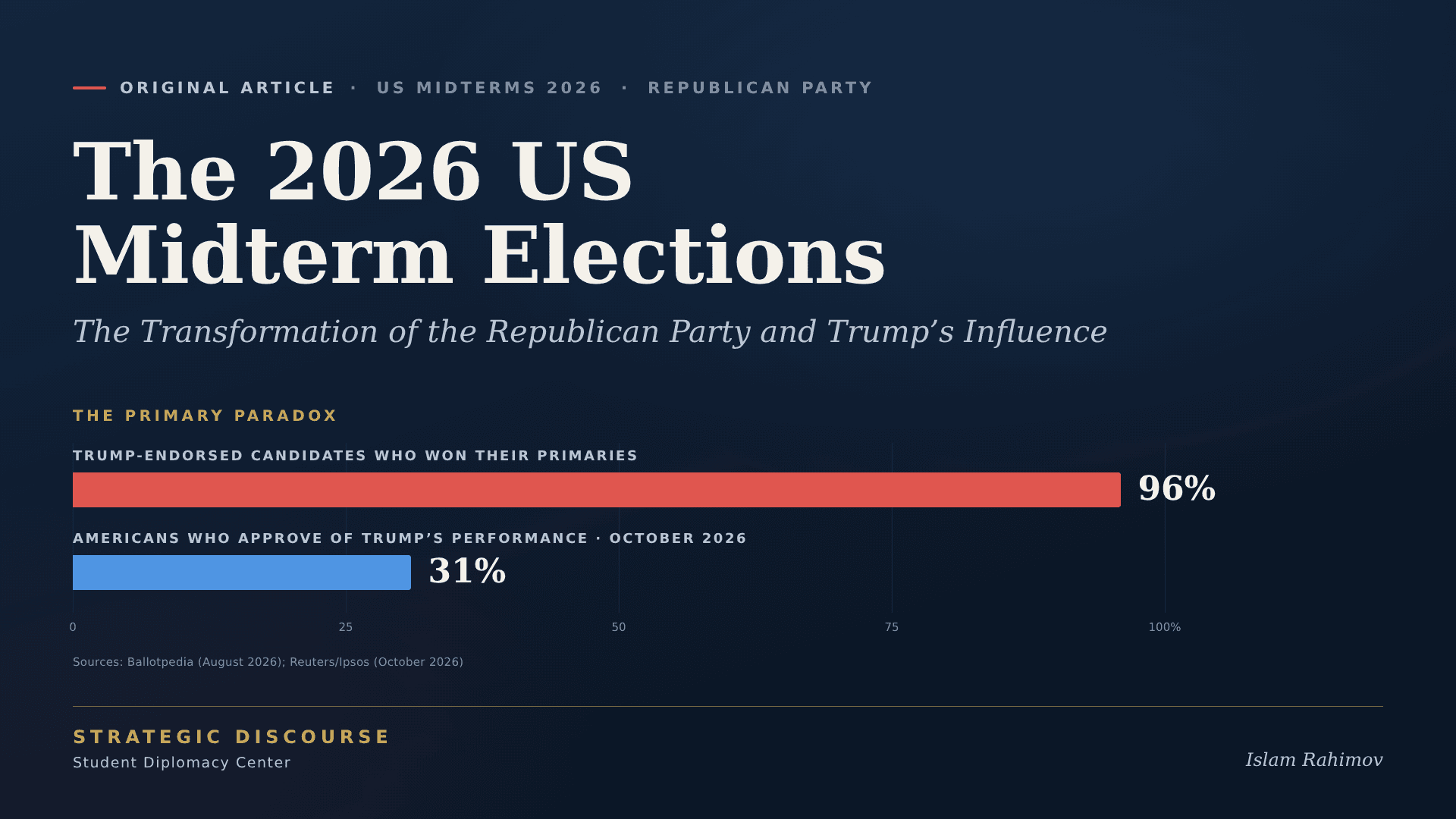
The midterm elections to the US Congress, to be held on 3 November 2026, are of great importance for assessing the internal transformation of the Republican Party and the limits of President Donald Trump’s political influence over the party. The defeat of senators such as Bill Cassidy and John Cornyn, as well as House member Thomas Massie, in intra-party primaries demonstrates Trump’s influence on the candidate selection process. In particular, Bill Cassidy finished third in the primary held in May 2026 and failed to advance to the runoff. Overall, 96 per cent of the 313 candidates Trump endorsed in this election cycle won their primaries. At the same time, in October 2026 the president’s approval rating fell to 31 per cent, while roughly two-thirds of Republican candidates running in competitive districts are distancing themselves from certain of Trump’s policies, which reveals the political dilemma facing the party. This contradiction is analysed as a “primary paradox”: the more the loyalty test strengthens discipline within the party, the greater the risks the party faces before a wider electorate. The article analyses the changing criteria of candidate selection in the Republican Party, Trump’s political strategy and the possible effects of this trend on the balance of power in Congress.
Keywords: midterm elections, Republican Party, Donald Trump, primaries, US Congress, party discipline
Introduction: The Political Significance of the 2026 Midterm Elections
In the midterm elections to be held in the United States on 3 November 2026, all 435 voting members of the House of Representatives and 35 members of the Senate will be elected. In addition to 33 regular Senate contests, two special elections will be held in Florida and Ohio. Republicans are defending 22 seats and Democrats 13. On the eve of the elections, Republicans hold a 53–47 majority in the Senate; this split includes two independent senators who caucus with the Democrats. Because the deciding vote in the event of a tie belongs to the Republican vice president, Democrats need a net gain of four seats to win a majority. In the House of Representatives, the Republican advantage is even narrower: under the current split, Republicans hold 219 seats, counting the support of one independent member, Democrats hold 214, and two seats are vacant [1].
Because US midterm elections are held two years after the presidential election, they are usually regarded as an important indicator of public attitudes towards the current administration’s policies. Of the 20 midterm elections held since 1946, the president’s party gained seats in the House of Representatives in only two – in 1998 and 2002 – while the average loss was about 26 seats [2]. These elections determine the ability of the president’s party to retain its positions in Congress and the opposition’s potential to influence the legislative process. Nevertheless, the results of midterm elections cannot be explained solely by the president’s popularity. The economic situation, the cost of living, voter turnout, local issues and the personal standing of candidates also influence voters’ decisions.
One of the key features distinguishing the 2026 elections is the struggle within the Republican Party over Donald Trump’s political influence. The MAGA movement – “Make America Great Again” – which has grown stronger under Trump’s leadership, is associated with a hard-line migration policy, an emphasis on national sovereignty, economic protectionism and the prioritisation of national interests in US foreign policy. MAGA is not merely an election slogan but also a political movement that shapes the Republican Party’s candidate selection and political agenda. Nevertheless, it would be wrong to assume that its supporters hold the same position on every issue.
The 2026 primaries showed that in the Republican Party, alongside candidates’ political experience and traditional conservative positions, having Trump’s endorsement is also a significant factor. However, it should be borne in mind that the president’s endorsement did not produce the same result in every race and that each candidate’s success depended on different political circumstances.
The main aim of the article is to examine Trump’s influence on candidate selection in the Republican Party on the basis of specific electoral cases and to assess the opportunities and risks that this influence may create for the party’s positions in the November elections.
1. Theoretical Framework: The Changing Criteria of Candidate Selection in the Republican Party
According to the approach that long dominated American political science, the decisive role in candidate selection is played by party elites. As shown in Cohen, Karol, Noel and Zaller’s “The Party Decides”, party leaders, donors and activists reach agreement among themselves before the primaries and present voters with “acceptable” candidates [3]. Levitsky and Ziblatt describe this function as the “gatekeeper” role of parties: by keeping extremist or anti-system candidates away from power, the party protects democratic institutions [4].
The Trump era has turned this model upside down. Today, the fate of a Republican candidate is determined not by agreement within the party elite but by the leader’s personal endorsement. In Robert Boatright’s research, the “primary threat” – that is, fielding a primary challenger against a legislator who strays from the party line – is described as an instrument of ideological polarisation [5]. In 2026, however, this instrument serves not ideology but loyalty to the leader himself. The gatekeeper has not disappeared; it has simply changed: whereas this role used to be played by the collective party leadership, it is now performed by a single person.
Two expectations follow from this framework. First, Republicans who oppose the leader in the primaries should face the risk of defeat, even if they have strong local positions. Second, candidates selected on the basis of loyalty should find it harder to attract a broader electorate in the general election. The following sections test these two expectations in turn.
Thus, it is more appropriate to assess the transformation of the Republican Party not as the complete disappearance of traditional conservatism but as a struggle for a new balance between ideological positions, electability and political loyalty to the president.
2. Donald Trump’s 2026 Electoral Strategy
One example of the growing importance of political loyalty in the Republican Party is the failure of Senator Bill Cassidy of Louisiana to advance to the runoff after finishing third in the primary. In 2021 Cassidy was one of seven Republican senators who voted to convict Donald Trump in his second impeachment trial [6]. This decision affected his relations with Trump and supporters of the MAGA movement in the years that followed.
Trump openly criticised Cassidy and backed his rival, House member Julia Letlow. In the primary held on 16 May 2026, Letlow won 45.2 per cent of the vote, State Treasurer John Fleming 28.3 per cent and Cassidy about 24 per cent. Having finished third, Cassidy failed to advance to the runoff. The runoff between Letlow and Fleming was held on 27 June, and Letlow defeated Fleming to become the Republican Party’s Senate nominee [6; 7].
After Cassidy failed to reach the runoff, Trump posted a harsh statement on Truth Social criticising his political loyalty and declaring that his political career was over. The statement demonstrated Trump’s attitude towards Cassidy and the importance he attaches to political loyalty in intra-party competition [6].
Although Cassidy’s failure shows the importance of Trump’s political endorsement in the primaries, the result cannot be explained by personal confrontation alone. The candidates’ campaigns, local voters’ preferences, Cassidy’s attitude towards Trump’s political course and intra-party competition in Louisiana were also part of this process.
This episode reflects a broader transformation within the party. Traditional conservative priorities – tax cuts, a tougher migration policy, limits on the powers of the federal government and national security – retain their importance. However, candidates’ attitudes towards Trump’s political agenda have also become an important criterion in election campaigns.
This change creates a certain tension between the party’s institutional leadership and political forces more closely tied to Trump. One of the main thrusts of Donald Trump’s 2026 electoral strategy is to back candidates close to his political line and to create conditions for alternative candidates to emerge against Republicans with whom he has openly disagreed. The president’s endorsement allows candidates to attract public attention, mobilise the voter base and amplify campaign messages. Nevertheless, the effect of such an endorsement is not the same in every electoral district.
The race in Texas between Senator John Cornyn and Attorney General Ken Paxton is an important example of this strategy. Cornyn, who had served in the Senate for many years, enjoyed the backing of the party’s institutional wing. Senate Majority Leader John Thune also supported his candidacy. Trump, however, came out on Paxton’s side [8; 9].
In the runoff held on 26 May, Paxton won the Republican Party’s Senate nomination. His victory can be seen as the result of the rivalry within the Texas Republican Party between the traditional political leadership and forces more closely tied to Trump [8].
Cornyn’s defeat showed that even long political experience and a financial advantage do not guarantee victory in the primaries. Nevertheless, Paxton’s primary victory does not mean that he has a definite advantage over his Democratic opponent James Talarico in November. Paxton’s record of political and legal controversies may give his opponents material for attack in the general election campaign [9]. It is therefore important to distinguish between winning the primary and the chances of winning the general election.
Trump’s strategy is not limited to backing challengers to incumbent senators. He also seeks to ensure that people close to his political line take their place in the party’s future ranks. Nevertheless, it would also be wrong to classify all the candidates Trump has endorsed simply as his personal followers. The candidates differ in their own political positions, their relations with the local electorate and their earlier standing within the party. Trump’s endorsement can create a political advantage, but the candidate’s own credibility with voters also remains important.
The figures also confirm the scale of this strategy. According to Ballotpedia data as of mid-August, Trump endorsed 313 candidates in this election cycle, and 96 per cent of them won their primaries. Eight of the 12 cases in which Trump-endorsed candidates lost were gubernatorial and state-level races [10].
These examples show that although Trump’s strategy has a significant impact on the Republican Party’s candidate selection process, its outcomes are not always predetermined. Contradictions between the president’s endorsement and the party’s institutional interests may affect the election results and future political relations.
3. The Intra-Party Struggle in the House of Representatives
Trump’s influence in the Republican Party is not limited to the Senate. The race involving Thomas Massie, who represents Kentucky’s 4th congressional district, is another important example of this influence. Massie was known for approaches that differed from Trump’s positions on federal spending, the president’s war powers and foreign policy. He also took a critical stance in debates on US aid to Israel and the role of pro-Israel organisations in foreign policy [11].
Trump openly criticised Massie and backed his rival, Ed Gallrein. In the Republican primary held on 19 May, Gallrein defeated Massie. The result once again brought to the fore the president’s influence on intra-party competition and the political risks faced by candidates who openly oppose Trump [11].
Another important feature of the race was the financial scale of the campaign. According to The Washington Post, the race between Massie and Gallrein became the most expensive House primary on record, with advertising spending exceeding 32 million dollars. The newspaper reported that political committees linked to AIPAC and the Republican Jewish Coalition each spent more than 4 million dollars on advertising against Massie [11].
These facts provide a basis for examining the role of political organisations and campaign finance in US elections. Nevertheless, it would be wrong to explain Massie’s defeat solely by the financial support of particular organisations. Trump’s open endorsement, the candidates’ political positions, voters’ attitudes and the overall course of the campaign may also have affected the result. Therefore, when linking campaign finance to an election result, one should rely on specific expenditures and their sources.
The Massie race shows that internal disagreements in the Republican Party are also linked to foreign policy. Some politicians who support Trump’s “America First” approach are cautious about foreign military interventions and aid to other countries. Nevertheless, it cannot be said that this approach is accepted in the same way by all MAGA supporters. Within the Republican Party there are differing positions on foreign policy, national security and presidential powers.
4. Discipline in the Senate: The Case of the Iran Resolution
Trump’s influence is not limited to candidate selection; it is also evident in legislative votes. The clearest example is the votes on resolutions that would end military operations against Iran conducted without the authorisation of Congress. On 19 May, the Senate voted 50–47 to discharge such a resolution from committee, opening the way for debate. Four Republicans – Bill Cassidy, Rand Paul, Lisa Murkowski and Susan Collins – voted in favour together with the Democrats [12]. It is worth noting that Cassidy cast this vote just three days after losing his primary.
A month later the picture changed. After a tense meeting between Republican senators and Trump [13], on 24 June the motion to proceed to S.J.Res.185 was rejected by 47 votes to 50. This time Cassidy voted against, while Rand Paul was recorded as “Present” (present but not voting) [14]. Paul explained his position openly: his aim was to give the president “more space and leverage to negotiate” [13]. Murkowski and Collins, for their part, did not change their positions.
This episode allows two conclusions. First, party discipline does not work through the electoral threat alone. Cassidy was already out of the primary race and has not publicly explained his change of position, so no firm conclusion can be drawn about his motives. But the timing of the vote – immediately after the meeting with the president – shows that direct political pressure is also an effective tool. Second, discipline is not absolute: senators such as Murkowski and Collins, who have an independent political base in their own states, continue to vote differently from Trump. From Azerbaijan’s perspective, these votes are of particular importance, as they concern military operations involving neighbouring Iran (see Section 7).
5. Trump’s Influence: Opportunities and Limitations
Trump’s strong position in the Republican Party creates several advantages. First of all, his endorsement helps raise candidates’ profiles and mobilise supporters. In the primaries, the president’s political clout can give candidates an edge over their rivals, shape the campaign agenda and energise the party’s active electorate.
The second advantage is that political messages within the party are presented in a more unified way. By emphasising similar positions on issues such as migration, the economy and the role of the federal government, Trump-endorsed candidates can offer voters a clear political direction. This is especially important for mobilising ideologically active voters in the primaries.
However, this influence also has limits, and they manifest themselves in three main areas.
First limitation: primary success does not transfer to the general election. A candidate who appeals to the party’s active electorate in the primary has to win the support of broader groups of voters in the general election. Defending all of Trump’s policies may be an advantage in some districts, but in others it may alienate independent and moderate voters. There is a clear example of this from the recent past: in the 2022 midterm elections, Mehmet Oz (Pennsylvania), Blake Masters (Arizona) and Herschel Walker (Georgia), whom Trump had endorsed in the primaries, won their party’s nomination but lost to Democrats in the general election, and Republicans failed to win a majority in the Senate [15]. The race in Texas illustrates this contradiction: becoming the Republican nominee with Trump’s endorsement brought Paxton success in the primary, but his chances in the general election must be assessed separately.
Second limitation: local political conditions and the candidate’s personal qualities. Although Trump’s endorsement is a significant resource in an election campaign, it cannot fully replace a candidate’s standing, political experience and voters’ expectations regarding local problems. The fact that the president’s endorsement plays an important role in the primaries does not mean that the outcome of every race is determined by this factor alone.
Third limitation: the need to preserve the party’s broader voter base. Putting political loyalty first in the primaries may strengthen unity within the party, but in the general election issues such as the economic situation, the cost of living, healthcare, employment and local problems also influence voters’ decisions. The main challenge facing the party is to strike a balance between benefiting from Trump’s political clout and preserving a broader voter base.
Hence, it is not enough to assess Trump’s intra-party influence solely by how many candidates win with his endorsement. To determine the broader political consequences of this influence, one must also look at these candidates’ results in the general election and their impact on the Republican Party’s positions in Congress.
6. October 2026: The Contradiction Between Intra-Party Loyalty and General Election Strategy
The trends observed in October 2026 show the dilemma facing the Republican Party even more clearly. According to a Reuters review published on 7 October, in 41 of the 62 competitive congressional races examined by the agency, Republican candidates have diverged from Trump’s positions on certain policy issues or sought to play down their ties to him. These differences have been observed in particular on Iran policy, data centres and beef imports. Reuters assesses this behaviour not as a complete break with Trump’s overall political agenda but as an attempt to attract independent and more moderate voters [16].
The important aspect of this observation is that most of the candidates do not reject Trump’s political course as a whole. Rather, they take different positions on specific issues or do not foreground their closeness to the president in their campaigns. Such an approach aims both at not losing the Republican Party’s active electorate and at appealing to broader groups of voters in competitive districts.
Thus, political loyalty in the primaries can give a candidate an advantage, but in the general election the same candidate has to make more complex political calculations. Although the president’s endorsement strengthens a candidate’s position within the party, the same endorsement may become a negative factor for some voters in certain districts.
In the battle for the Senate, Texas is a significant example of this contradiction. A Reuters analysis published on 12 October listed states such as North Carolina, Ohio, Alaska and Iowa, alongside Texas, as key battlegrounds in the fight for a Senate majority. The article noted that the race in Texas between Democratic candidate James Talarico and Republican Ken Paxton had become competitive [17].
National polls point in the same direction. According to a Reuters/Ipsos poll completed on 19 October, the share of Americans approving of Trump’s performance fell to 31 per cent, the lowest figure in either of his presidential terms. Forty-seven per cent of registered voters said they were prepared to vote for the Democrats and 35 per cent for the Republicans [18].
According to the European Parliamentary Research Service briefing of 9 October 2026, forecasts on the eve of the elections suggested that the Democrats could gain the upper hand in the House of Representatives, while the race for the Senate was more open. The briefing lists the cost of living, inflation, housing, healthcare, employment and issues related to data centres among the main problems voters are paying attention to [1].
These issues show that the problem facing the Republican Party is not limited to leadership and candidate selection. At the same time, the party must respond to the economic situation, public discontent and the expectations of independent voters. Trump’s political clout remains an important resource in the primaries, but success in the general election also depends on candidates’ positions on broader political and social issues.
Nevertheless, with only a few weeks left before the elections, the final results cannot be determined with certainty on the basis of current trends. Voter turnout, the final stage of the campaigns, the economic situation and political events may affect the results. Election forecasts should therefore be treated not as established facts but as probabilities based on the available data.
7. What Does This Mean for Azerbaijan and the Region?
US domestic elections may seem far removed from Baku, but the composition of Congress directly affects at least three sensitive areas of Azerbaijan–US relations.
First, Section 907 of the Freedom Support Act. After the Washington summit of 8 August 2025, the US administration extended the waiver of this section; on 1 June 2026, President Ilham Aliyev thanked Donald Trump for the relevant memorandum [19]. However, the full repeal of Section 907 lies within the powers not of the president but of Congress. The full repeal of Section 907 and the TRIPP project (Trump Route for International Peace and Prosperity) were also discussed at the meeting between Foreign Minister Jeyhun Bayramov and Republican Congressman Abraham Hamadeh on 17 June [20]. If Republicans retain their majority in both chambers, the likelihood of this issue reaching the agenda would increase. Democratic control of the House of Representatives, on the other hand, could complicate the process, since in Congress this topic is closely linked to human rights and civil society issues [19].
Second, the Strategic Partnership Charter. The charter, signed in Baku on 10 February 2026 by US Vice President J.D. Vance and President Ilham Aliyev, provides for cooperation on the Middle Corridor, energy, critical minerals and digital infrastructure [19]. Although the implementation of the charter depends mainly on the executive branch, the expansion of defence cooperation and funding issues go through Congress.
Third, and perhaps most importantly, Iran. The votes analysed in Section 4 show that Iran policy has become one of the most sensitive intra-party issues in Congress. A Democratic majority in either chamber could strengthen efforts to place legal limits on US military operations against Iran. For Azerbaijan, this matters both for the security situation on its southern border and for the prospects of the TRIPP project, which faces serious security and financial risks against the backdrop of US–Iran tensions [19].
Thus, for Baku the main question of the November elections is not “who will win?” but “to what extent will Congress constrain Trump’s foreign policy?”
8. Possible Scenarios
Depending on the outcome of the elections, three main scenarios can be considered. These scenarios do not predetermine the final result of the elections; they are presented to explain how the possible balance of power in Congress could affect the Republican Party’s internal politics and Trump’s influence over the party. Since election forecasts may change, these options should be treated not as firm probabilities but as conditional analytical scenarios.
Scenario 1: Republicans retain control of both chambers. In this case, Trump’s intra-party influence could be consolidated and the positions of candidates close to the MAGA line could be strengthened. Nevertheless, such an outcome would not remove the party’s need to appeal to independent and moderate voters.
Scenario 2: Democrats gain the upper hand in the House of Representatives, while Republicans retain their majority in the Senate. In this case, political confrontation in Congress may continue. Within the Republican Party, debates on how to assess the general election results and how to approach a broader voter base may intensify.
Scenario 3: Democrats gain the upper hand in both chambers. In this case, debates within the Republican Party over electoral strategy and leadership could intensify even further. Nevertheless, it cannot be said in advance that such an outcome would automatically bring Trump’s leadership to an end.
These scenarios show that the 2026 elections may determine not only the composition of Congress but also the Republican Party’s future political strategy. The key question is to what extent Trump’s influence in the primaries will translate into the party’s results in the general elections.
Conclusion
The 2026 midterm elections are an important test of the relationship between leadership, political loyalty and institutional traditions in the Republican Party. The first expectation put forward in the article is confirmed: within the party, Trump’s influence is almost decisive. The defeat of Bill Cassidy and John Cornyn in the primaries, Thomas Massie’s failure to win renomination and the victory of 96 per cent of Trump-endorsed candidates show that the party’s traditional “gatekeeper” function has passed from the collective leadership to the leader himself. Although local conditions, campaign finance and candidates’ personal positions affect the outcome of individual races, they do not change this general pattern.
The second expectation reveals the essence of the “primary paradox”: loyalty that gives an advantage in the primaries can become a liability in the general election. The president’s approval rating has fallen to 31 per cent, Republican candidates in roughly two-thirds of competitive races are distancing themselves from him, and the experience of 2022 has already shown that candidates nominated with Trump’s endorsement can lose in the general election. The dilemma facing the party is this: to benefit from the president’s endorsement in the primaries while at the same time attracting broader groups of voters in the general election. These two goals do not always complement each other. The race between Ken Paxton and James Talarico in Texas will be the clearest test of this paradox.
The future direction of the Republican Party will depend on what conclusion is drawn from this paradox. Defeat in the general election could reopen the debate on the balance between the leader-centred political model and institutional conservative traditions; success, by contrast, would reinforce the belief that the loyalty test carries no electoral risk.
For Azerbaijan, the significance of the elections is measured by the impact of the balance of power in Congress on US foreign policy. Issues such as the full repeal of Section 907, the expansion of defence cooperation under the Strategic Partnership Charter and war powers concerning Iran go directly through Congress. For this reason, 3 November will shape not only American domestic politics but also the next two years of US policy in the South Caucasus.
In this sense, the November elections will be an important indicator not only of the distribution of seats in Congress but also of the real political limits of Trump’s influence over the Republican Party.
References
Delivorias, A., Kuljanic, N. (2026). Understanding the 2026 United States midterm elections: Contested seats, voter concerns and possible changes in Congress. European Parliamentary Research Service, 9 October 2026.
https://eprs.europarl.europa.eu/contents/publications/EPRS/2026/10/EPRS_BRI%282026%29791533.html
The American Presidency Project. Seats in Congress Gained/Lost by the President’s Party in Mid-Term Elections. University of California, Santa Barbara.
https://www.presidency.ucsb.edu/statistics/data/seats-congress-gainedlost-the-presidents-party-mid-term-elections
Cohen, M., Karol, D., Noel, H., Zaller, J. (2008). The Party Decides: Presidential Nominations Before and After Reform. Chicago: University of Chicago Press.
Levitsky, S., Ziblatt, D. (2018). How Democracies Die. New York: Crown.
Boatright, R. G. (2013). Getting Primaried: The Changing Politics of Congressional Primary Challenges. Ann Arbor: University of Michigan Press.
Reuters. (2026). Republican Senator Cassidy loses re-election to Trump retribution campaign. 16 May 2026.
https://www.reuters.com/world/us/republican-cassidy-faces-trump-retribution-effort-louisiana-senate-primary-2026-05-16/
Reuters. (2026). Trump-backed Senate candidate wins Republican primary in Louisiana. 28 June 2026.
https://www.reuters.com/world/us/trump-backed-senate-candidate-wins-republican-primary-louisiana-2026-06-28/
Birenbaum, G., Guo, K., Martinez, A. (2026). Ken Paxton defeats John Cornyn for U.S. Senate GOP nomination. The Texas Tribune, 26 May 2026.
https://www.texastribune.org/2026/05/26/texas-john-cornyn-ken-paxton-us-senate-republican-primary-runoff/
Galston, W. A. (2026). Paxton’s landslide win signals end of Bush-era Texas GOP. Brookings Institution, 28 May 2026.
https://www.brookings.edu/articles/paxtons-landslide-win-signals-end-of-bush-era-texas-gop/
Colorado Politics. (2026). Trump has a 96% endorsement success rate. Here are the Republicans he’s backed who have lost. 19 August 2026 (based on Ballotpedia data).
https://www.coloradopolitics.com/2026/08/19/trump-has-a-96-endorsement-success-rate-here-are-the-republicans-hes-backed-who-have-lost/
Knowles, H. (2026). Rep. Thomas Massie loses GOP primary, the latest casualty of Trump’s wrath. The Washington Post, 19 May 2026.
https://www.washingtonpost.com/politics/2026/05/19/thomas-massie-faces-ed-gallrein-kentucky-gop-primary-with-massive-spending/
Berger, H. (2026). Senate advances resolution to curb Trump’s Iran war powers. The American Conservative, 19 May 2026.
https://www.theamericanconservative.com/senate-advances-resolution-to-curb-trumps-iran-war-powers/
Jewish Insider. (2026). Senate blocks effort to advance war powers resolution in reversal after heated GOP meeting with Trump. June 2026.
https://jewishinsider.com/2026/06/senate-blocks-war-powers-resolution-trump-republicans/
United States Senate. (2026). Roll Call Vote 192, 119th Congress, 2nd Session (On the Motion to Proceed, S.J.Res.185). 24 June 2026.
https://www.senate.gov/legislative/LIS/roll_call_votes/vote1192/vote_119_2_00192.htm
Jacobson, G. C. (2023). The 2022 Elections: A Test of Democracy’s Resilience and the Referendum Theory of Midterms. Political Science Quarterly, 138(1).
Reuters. (2026). Most Republicans in tight midterm races distance themselves from Trump, Reuters review finds. 7 October 2026.
https://www.reuters.com/world/us/most-republicans-tight-midterm-distance-themselves-trump-reuters-review-finds-2026-10-07/
Reuters. (2026). The races that will decide control of the US Senate. 12 October 2026.
https://www.reuters.com/legal/government/races-that-will-decide-control-us-senate-2026-10-12/
Lange, J. (2026). Exclusive: Trump approval falls to record low of 31% as midterms near, Reuters/Ipsos poll finds. Reuters, 19 October 2026 (via The Star).
https://www.thestar.com.my/news/world/2026/10/20/exclusive-trump-approval-falls-to-record-low-of-31-as-midterms-near-reutersipsos-poll-finds
JAMnews. (2026). Vaşinqtonun Cənubi Qafqaz planı: Azərbaycanla strateji tərəfdaşlığın fonunda nə dayanır? [Washington’s South Caucasus plan: what lies behind the strategic partnership with Azerbaijan?]. 2 June 2026.
https://jam-news.net/az/?p=105795
Report.az. (2026). Ceyhun Bayramov Abraham Hamade ilə TRIPP layihəsini müzakirə edib [Jeyhun Bayramov discussed the TRIPP project with Abraham Hamadeh]. 17 June 2026.
https://report.az/xarici-siyaset/ceyhun-bayramov-abraham-hamade-ile-gorusub
Comments (0)
No comments yet. Be the first!
Related posts

the 2nd International Conference of Leading National Analytical Centers of the Organization of Turkic States

On September 17, an expert platform meeting was held to mark the anniversary of the restoration of state sovereignty.

"Strategic Discourse" Centre Takes Part in DGAP Panel Discussion on Digital Influence and Public Diplomacy