
What Is Happening to Democracy?

ORIGINAL ARTICLE
What Is Happening to Democracy?
On the Concept of Democratic Backsliding
Musabay Babayev
Master’s program “Public Affairs and Democracy”
Leuphana University Lüneburg, Germany
Executive Director of the “Strategic Discourse” Student Diplomacy Center
Correspondence
Musabay Babayev, Leuphana University Lüneburg, Universitätsallee 1, 21335 Lüneburg, Germany.
Abstract
The concept of democratic backsliding is widely used in contemporary political analysis, but it is rarely examined in a systematic way. The article discusses the difficulties related to the Eurocentric and normatively loaded character of this concept, and raises the question of the starting point against which “backsliding” is recorded. The paper draws on the debate around the definition of democratic backsliding and offers a critical view of the ways in which it is conceptualized.
Keywords: democracy, democratic backsliding, liberal constitutional democracy, Eurocentrism, V-Dem
What is happening to democracy?
A significant share of recent analytical reports loudly presents democratic backsliding as a kind of threat to national security in some countries. The Democracy Report 2026 of the Swedish V-Dem Institute states that, measured by the average world level of democracy, the world has slid back to 1978. A “backslide”, a “counter-revolution”, is unfolding against liberal constitutional democracy. Liberal democracy had been under pressure and on the defensive long before COVID-19. Already before the pandemic, its opponents had a whole list of accusations. Populists argued that liberalism had become a cover for anti-democratic elitism, which takes power away from ordinary citizens and undermines their economic interests. Nationalists claimed that liberalism had produced international institutions and laws that intrude on state sovereignty and prevent the realization of legitimate national interests. Cultural traditionalists argued that liberal individualism erodes moral and religious communities, and that liberal freedom blurs the line between liberty and permissiveness. Liberal democrats, in turn, accused their opponents of sliding towards authoritarianism, of using sovereignty as a screen for human rights violations, and of a return to “zero-sum” politics. As one of the leading specialists in comparative politics notes, the concept of democratic backsliding is “often used, but rarely analyzed”.
What is democratic backsliding?
Many academic works on democratic backsliding concentrate on the mechanisms of attacks on democracy. These include coups d’état, executive aggrandizement, the dismantling of checks and balances, the elimination of political institutions, and electoral manipulation. The main fundamental question, however, largely remains open: how can we actually understand that a democracy has stopped being a democracy and that backsliding has become inevitable? The most widespread empirical and conceptual theories of democracy (Bermeo; Lührmann–Lindberg) are too Eurocentric. Democracy itself is very diverse, and the very concept of backsliding is Eurocentric and normatively loaded. The word itself implies a movement “down” from some ideal. Bermeo (2016) admits this, noting that the term refers to a “deliberate departure from the ideal”. The problem is that this ideal is usually not made explicit; it is silently identified with liberal constitutional democracy of the Western type, with strong independent courts. This rests on a historicist premise, according to which all societies must pass through the same stages as Europe — feudalism, capitalism, industrial modernity, and liberal democracy. An idea that places liberal democracy at the top of the scale by definition codes any institutional deviation as “regression”. In this way, the concept of backsliding structurally reproduces what Chakrabarty (Provincializing Europe, 2000) calls measuring the non-Western world against a Western standard.
Backsliding from where? The problem of the starting point
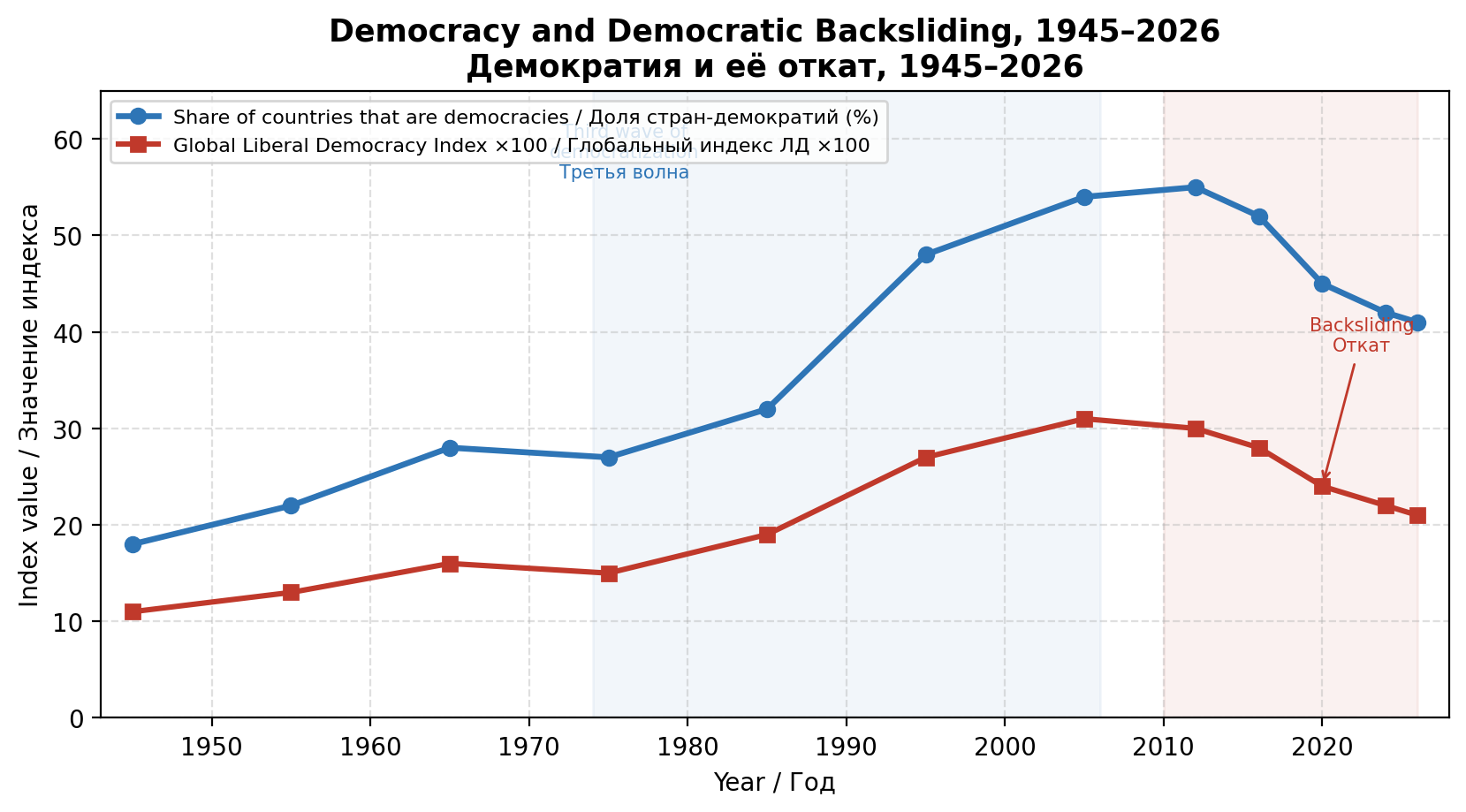
The figure displays the V-Dem index of democracies and autocracies across the world. For V-Dem, democratic backsliding is by definition a movement “down” from some starting point, which means that any claim about backsliding logically requires a definition of this starting point — the reference point. It is exactly here that the concept of backsliding reveals its most vulnerable methodological side. To argue that a democracy has “slid back”, the researcher first has to set point A — the level of democracy from which the decline is counted. On closer inspection, however, it becomes clear that the single label of “backsliding” hides different problems, which are systematically mixed together in the existing literature. As we can see in the figure, point A is taken from the peak of both curves around 2006–2012, and the red “Backsliding” zone starts immediately after it, showing the movement down from this maximum. Here the authors used point A as a global aggregate, but they forget that a country which has never reached the level of liberal democracy cannot, in the strict sense, “slide back” from it. What looks like a decline on the V-Dem index chart may in fact mean something quite different. Frequent cases are “failed democratization” and the “return of an authoritarian regime”. Failed democratization is a transition that started but stopped before reaching consolidation, while the return of an authoritarian regime usually takes place after a short period of liberalization.
Where is the threshold? The problem of the moment when a democracy ceases to be a democracy
Democracy itself is not a binary but a graded variable, while backsliding requires a clear boundary, a moment of transition. Researchers thus try to make sense of a continuous quantity through the category of a break. At the same time, the empirical difference between an index value of 0.43 and 0.42 is negligible and may simply reflect measurement error. If the threshold is set at 0.425, this negligible difference turns a country from a “democracy” into an “autocracy”. Different methods are used to solve the threshold problem, but each method has its own difficulties. The dichotomous — or, as it is sometimes called, minimalist — approach, created by Schumpeter and developed by Przeworski and Cheibub, defines democracy through the real alternation of power as a result of competitive elections. The threshold is the turnover test, which asks whether the incumbents are able to lose elections and give up office. The strength of this approach is that it does not require agreement on what a “good” democracy should look like. Its weakness, however, is its blindness to the gradual erosion of elections. Elections may formally remain competitive despite the destruction of judicial independence and press freedom, and the approach does not capture this fact.
The second and more widespread method is the continuous, graded approach. This approach, of course, abandons a single boundary in favor of a scale on which any decline is recorded. It is highly sensitive to nuance, but here as well the decision about what counts as democracy is made by the methodologist.
Who sets the ideal? The normative anchoring of the reference point
In most cases, the default reference point is not the empirical past state of a specific country, but a normative ideal in the form of Western-style liberal constitutional democracy with strong independent courts. This is exactly what Bermeo calls a “deliberate departure from the ideal”. The problem, however, is that this ideal is external and universalized. As a result, point A for a non-Western country turns out to be not its own history, but the projection of a Western norm onto its trajectory. “Backsliding” then no longer measures a real change of the political regime, but the distance to the West. Any non-Western configuration of power is automatically coded as a deficit, as a deviation from the standard. Here the problem of the reference point finally merges with what Chakrabarty (Provincializing Europe, 2000) calls measuring the non-Western world against a Western standard. The concept of backsliding builds a normative hierarchy into its very structure: liberal democracy stands at the top, and everything else is defined through its degree of distance from it.
From “backsliding” to regime trajectory
The critique of the backsliding concept does not have to end with deconstruction. It leads to a quite concrete research program. The main flaw of the existing approach is its binary logic, in which a regime is either a “democracy” or is “backsliding” away from it. Yet, as Levitsky and Way show, between these poles lies a broad and stable zone of competitive authoritarianism. To regimes that do not move “down” from some peak but reproduce a hybrid equilibrium, the language of “backsliding” simply does not apply. Instead of comparing a country with a universal standard (cross-case), what is needed is the tracking of its own trajectory over time (within-case). This move also finds support within the critical theory of backsliding itself. Wolkenstein, for example, proposes to diagnose backsliding through the method of immanent critique. In essence, this is the same move as the shift from cross-case to within-case analysis: in both, the reference point is no longer a universal standard but the internal measure of the regime itself. The difference is that immanent critique works at the level of a qualitative analysis of a single case, while the within-case approach transfers the same logic to the systematic tracking of a trajectory over time. The reference point then becomes not an ideal but the empirically observed past state of the regime itself, and the analyst is able to separate three phenomena: failed democratization, the return of authoritarianism, and the actual backsliding of a consolidated democracy.
Conclusion
So what is happening to democracy? A correct answer requires, first of all, reformulating the question itself. V-Dem is not a photograph of one single process; it is an overlay of heterogeneous trajectories of different regimes, brought together into one line by a methodological decision. It does show that elections are eroding and that executive power is advancing on the courts and the press. But to call this a global “backsliding” means mistaking the distance to the Western norm for a change of the regime as such. If, instead, we measure each country against its own history and honestly distinguish between types of trajectories, the picture stops being a single catastrophe and becomes a mosaic of processes moving in different directions, only some of which deserve the name of democratic backsliding. Democracy is not so much retreating everywhere as slipping away from an instrument that was not designed to measure it beyond the West.
References
Bermeo, N. (2016). On Democratic Backsliding. Journal of Democracy, 27(1), 5–19.
Chakrabarty, D. (2000). Provincializing Europe: Postcolonial Thought and Historical Difference. Princeton: Princeton University Press.
Cheibub, J. A., Gandhi, J., & Vreeland, J. R. (2010). Democracy and Dictatorship Revisited. Public Choice, 143(1–2), 67–101.
Levitsky, S., & Way, L. A. (2010). Competitive Authoritarianism: Hybrid Regimes after the Cold War. Cambridge: Cambridge University Press.
Lührmann, A., & Lindberg, S. I. (2019). A Third Wave of Autocratization Is Here: What Is New About It? Democratization, 26(7), 1095–1113.
Przeworski, A. (1991). Democracy and the Market: Political and Economic Reforms in Eastern Europe and Latin America. Cambridge: Cambridge University Press.
Schumpeter, J. A. (1942). Capitalism, Socialism and Democracy. New York: Harper & Brothers.
V-Dem Institute. (2026). Democracy Report 2026. Gothenburg: University of Gothenburg, V-Dem Institute.
Wolkenstein, F. (2023). What Is Democratic Backsliding? Constellations, 30(3), 261–277.
Comments (0)
No comments yet. Be the first!
Related posts

"Strategic Discourse" Centre Takes Part in DGAP Panel Discussion on Digital Influence and Public Diplomacy
Iran After Khamenei

"Strategic Discourse" Center Participates in "Entangled Histories" Conference at GIGA
The strategic confrontation between the United States and China on the example of Latin America
"Strategic Confrontation between the US and China as Exemplified by Latin America: A Brief Overview," an article by Musabey Babaev, Director of the "Strategic Thinking" Student Diplomacy Center, has been published on the Vesti.az news portal. Link: https://vesti.az/v-mire/strategiceskoe-protivostoyanie-ssa-i-kitaya-na-primere-latinskoi-ameriki-situaciya-583705